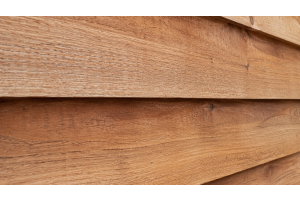
How long does cedar siding last?
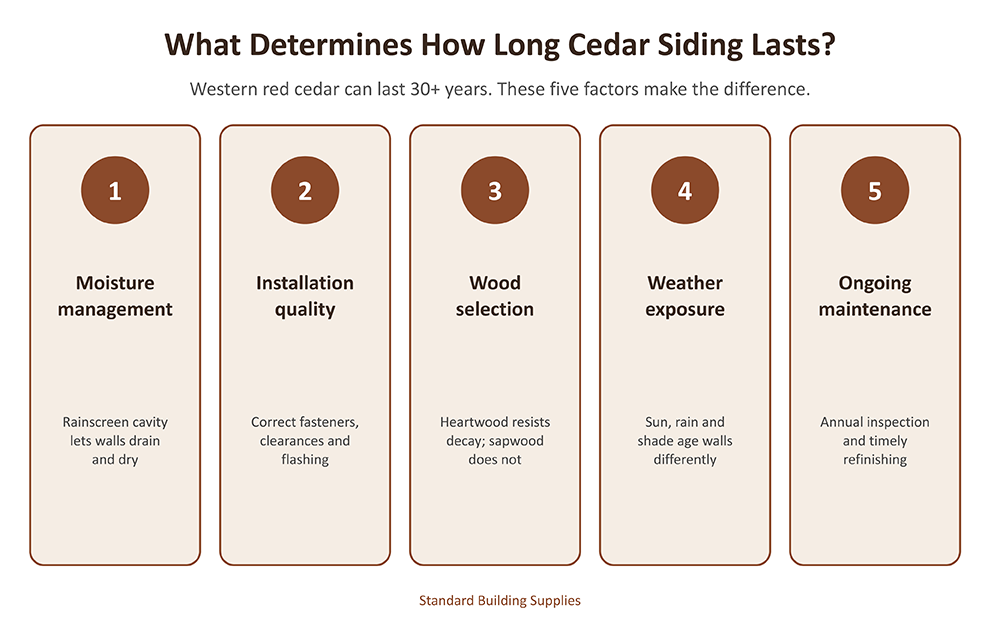
There's no single answer, because how long cedar siding lasts depends mostly on how it's installed and maintained. Western red cedar contains natural tannins and oils that help it resist decay, which makes it well suited to British Columbia's climate. Moisture management, weather exposure, installation quality and regular inspection and upkeep all affect how well it performs over time.
Cedar Siding Maintenance at a Glance
- Lifespan: Depends mainly on installation quality, moisture management and ongoing maintenance.
- Cleaning: Inspect siding annually and clean it gently as needed to remove dirt, algae and debris.
- Finishing: Stains and protective coatings may need reapplication depending on the product and exposure.
- Moisture: Good drainage and ventilation are essential for long-term performance.
- Weathering: Unfinished cedar naturally changes to a silver-grey colour over time.
Cedar Siding Maintenance Options
| Maintenance Method | Purpose | Key Consideration |
|---|---|---|
| Cleaning | Removes dirt, mildew and surface buildup | Use gentle methods to avoid damaging the wood |
| Staining | Adds colour and helps protect against weathering | Reapplication depends on the finish and exposure |
| Clear or water-repellent finish | Helps limit moisture absorption | Most clear finishes offer little UV protection and typically need recoating every 1–2 years |
| Painting | Provides an opaque protective finish | Requires a stain-blocking primer, suitable preparation and ongoing upkeep |
| Leaving unfinished | Allows natural silver-grey weathering | Colour may develop unevenly |
What Makes Cedar Siding Durable?
All western red cedar contains natural tannins and oils that help it resist decay and support its longevity. It is also relatively dimensionally stable, meaning it generally experiences less movement from changes in moisture than many other wood species.
However, natural durability doesn't eliminate the need for proper installation. Cedar siding performs best when water can drain away and the wood can dry after rain.
In much of coastal B.C., the BC Building Code requires a rainscreen wall assembly: a drained and vented air gap behind the siding that prevents moisture from becoming trapped and allows the back of the boards to dry.
Fasteners matter too. Use stainless steel or hot-dipped galvanized nails, as plain steel fasteners can react with cedar's natural tannins and leave dark streaks on the siding. Standard Building Supplies carries a range of fasteners for construction projects. Sealing or priming cut ends, and back-priming boards before installation, also helps limit moisture absorption.
What Maintenance Does Cedar Siding Need?
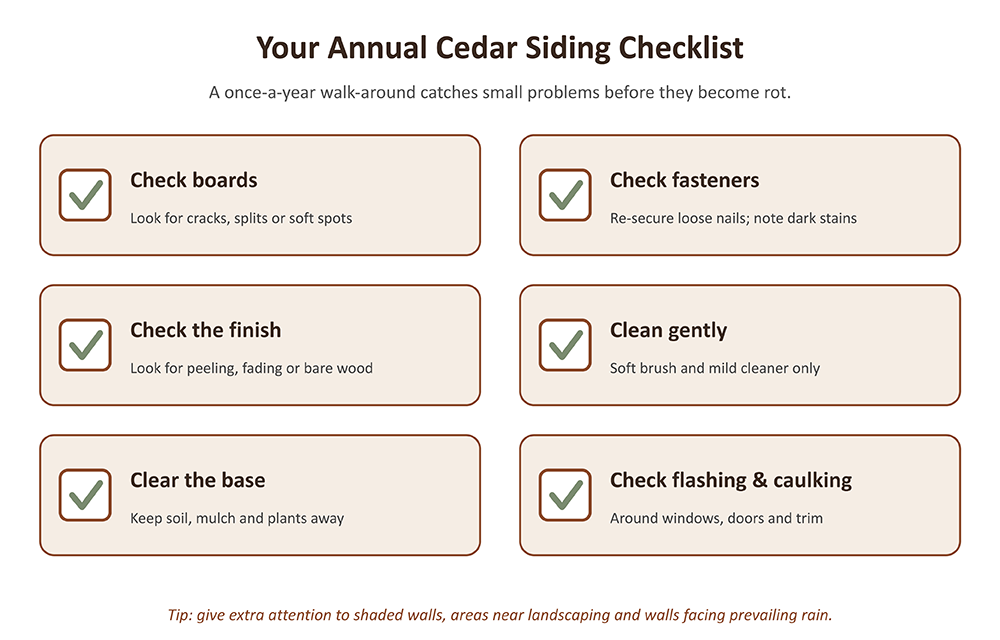
Cedar siding benefits from regular inspection and basic upkeep.
- Inspect annually: Look for damaged boards, loose fasteners, peeling finishes and areas where moisture may collect.
- Clean as needed: Remove dirt, algae and debris using a soft brush and an appropriate mild cleaner. Avoid aggressive pressure washing.
- Maintain finishes: Follow the coating manufacturer's recommendations for cleaning and reapplication.
- Keep drainage clear: Prevent soil, vegetation and debris from holding moisture against the siding, and maintain the required clearance between the bottom of the siding and finished grade (typically at least 200 mm, or about 8 inches).
Pay particular attention to shaded walls, areas near landscaping and locations exposed to persistent rain.
Staining vs. Painting vs. Natural Weathering
The right approach depends largely on the appearance you want to maintain.
| Finish | Main Advantage | Maintenance Consideration |
|---|---|---|
| Semi-transparent stain | Preserves visible wood grain while adding colour | Requires periodic reapplication |
| Solid-colour stain | Provides more uniform colour and greater UV protection | May require surface preparation before recoating |
| Paint | Offers an opaque finish and broad colour selection | Needs a stain-blocking primer to prevent tannin bleed; can peel if moisture becomes trapped |
| Unfinished cedar | Develops a natural weathered appearance | May weather unevenly depending on exposure |
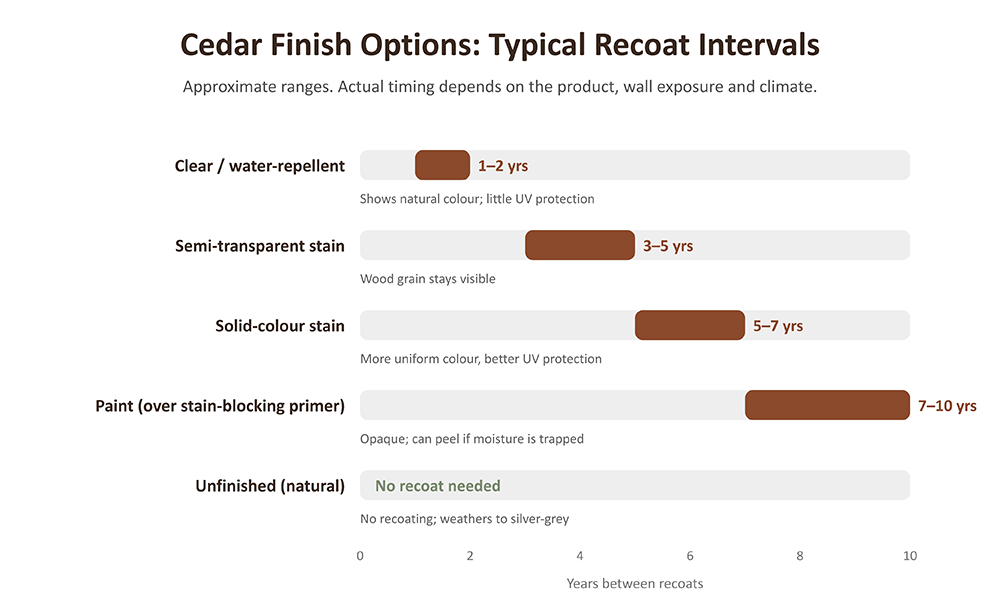
For homeowners who want to preserve cedar's original warm colour, a suitable exterior finish with UV protection is generally preferable to leaving the wood untreated.
Which Cedar Siding Maintenance Approach Should You Choose?
If maintaining cedar's original colour is important, choose an exterior wood finish designed for cedar and follow the manufacturer's maintenance schedule.
If you prefer a natural silver-grey appearance, leaving cedar unfinished may be appropriate, provided the siding is correctly installed and allowed to dry.
Regardless of the finish, proper drainage, ventilation and regular inspection are more important to long-term durability than appearance alone.
Frequently Asked Questions
How often should cedar siding be stained?
It depends on the product, exposure and condition of the existing finish. As a general guide, semi-transparent stains often need recoating every 3 to 5 years, solid-colour stains every 5 to 7 years and paint every 7 to 10 years, while clear finishes may need attention every 1 to 2 years. South- and west-facing walls usually need attention sooner. Follow the manufacturer's recommendations and inspect the siding regularly.
Does cedar siding need to be sealed?
Not necessarily. Western red cedar can be left unfinished, but suitable exterior finishes can help manage moisture absorption and protect its appearance. Keep in mind that most clear finishes offer limited UV protection and need more frequent reapplication than stains.
Can you pressure wash cedar siding?
High-pressure washing can damage cedar's relatively soft surface and force water into joints. Gentle cleaning with a soft brush and appropriate cleaner is generally safer.
Does cedar siding rot in wet climates?
Western red cedar's natural tannins and oils help it resist decay, but prolonged moisture exposure without adequate drying can still lead to deterioration. Proper drainage and ventilation are particularly important in B.C.'s coastal climate.
Can old cedar siding be restored?
Often, yes. Cedar siding with surface discolouration or a weathered finish may be cleaned and refinished. Boards with significant decay, splitting or other damage may need replacement.
What nails should you use for cedar siding?
Use stainless steel or hot-dipped galvanized nails. Plain steel or electro-galvanized fasteners can corrode and react with cedar's natural tannins, causing dark stains around the nail heads.
Cedar Siding Products at Standard Building Supplies
As a member of the Western Red Cedar Lumber Association (WRCLA), Standard Building Supplies stocks quality-graded cedar siding. Whether you're planning a new cedar siding project or replacing weathered boards, our team can help you choose the right grade, profile and finish for your home.